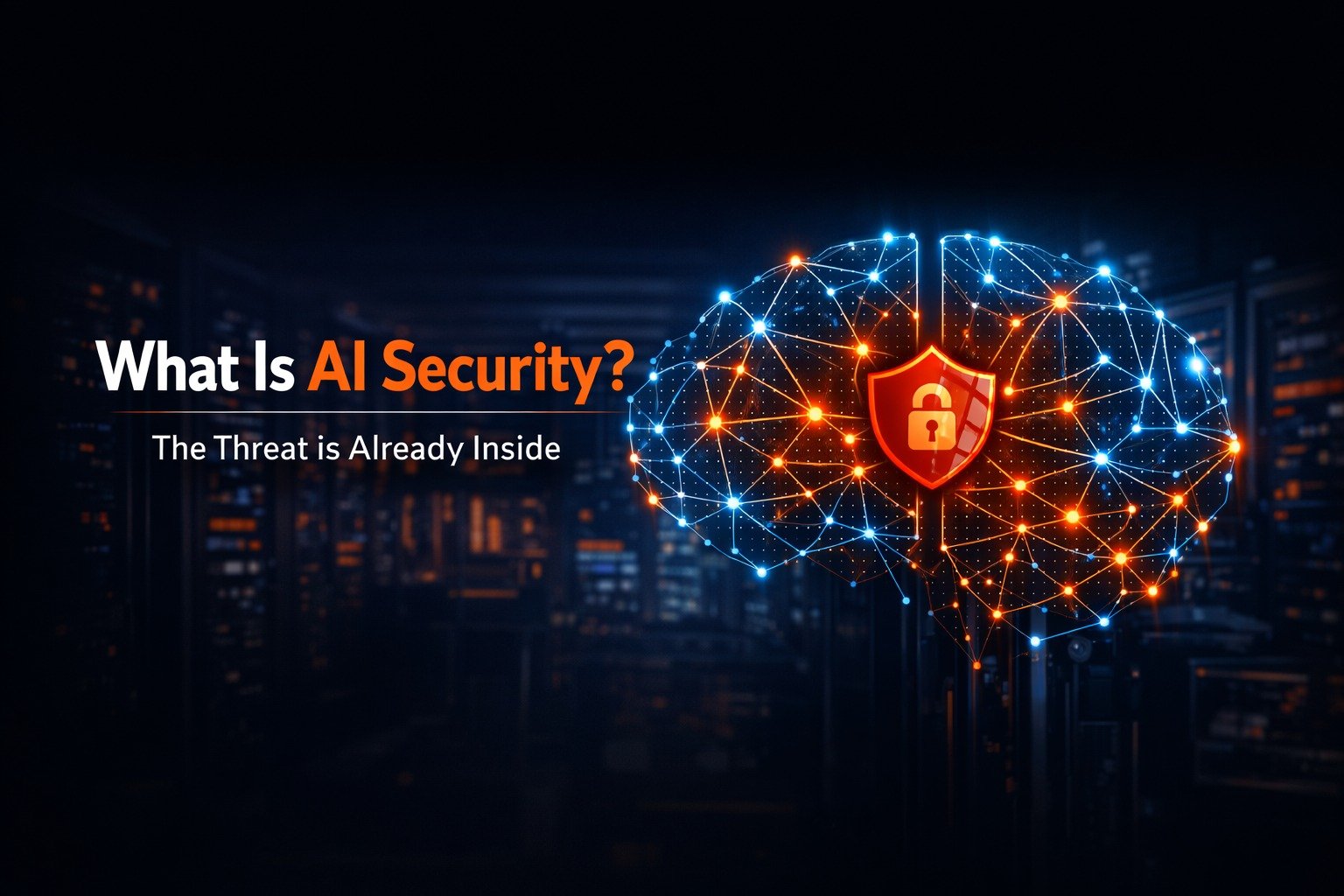
Your organisation has spent thousands securing the perimeter. Firewalls. Access controls. Security cameras. All pointing outward.
But the threat is already inside. And it walked in through your AI tools.
AI is moving fast. Faster than most security teams can keep up with. And while businesses race to adopt it, the risks are quietly multiplying. In this post I want to break down exactly what AI security means, what the real threats look like right now, and what every organisation should be doing about it. No technical jargon. Just straight talk.
What Is AI Security and Why Should You Care
AI security is not a single thing. It is a combination of practices, policies and technologies designed to protect AI systems and the data they use from being attacked, misused or manipulated.
At the foundation of any security conversation are three core principles. Confidentiality means keeping sensitive information private so only the right people and systems can access it. Integrity means ensuring information is accurate and has not been tampered with. Availability means the systems people rely on are accessible when they need them, not locked down or disrupted by an attack.
AI security applies all three of these principles to everything an AI system touches. The data it trains on. The outputs it generates. The decisions it makes.
What makes AI security uniquely challenging is that AI systems are not static. They learn, they adapt and they connect to vast amounts of data. That means the attack surface is significantly larger than with traditional software. And the consequences of a breach are proportionally larger too.
“Security must be designed into every layer rather than treated as an afterthought.”
Avijit Patra, AI Agile Synergy Webinar (1:28)
AI Is Making Security Better and Worse at the Same Time
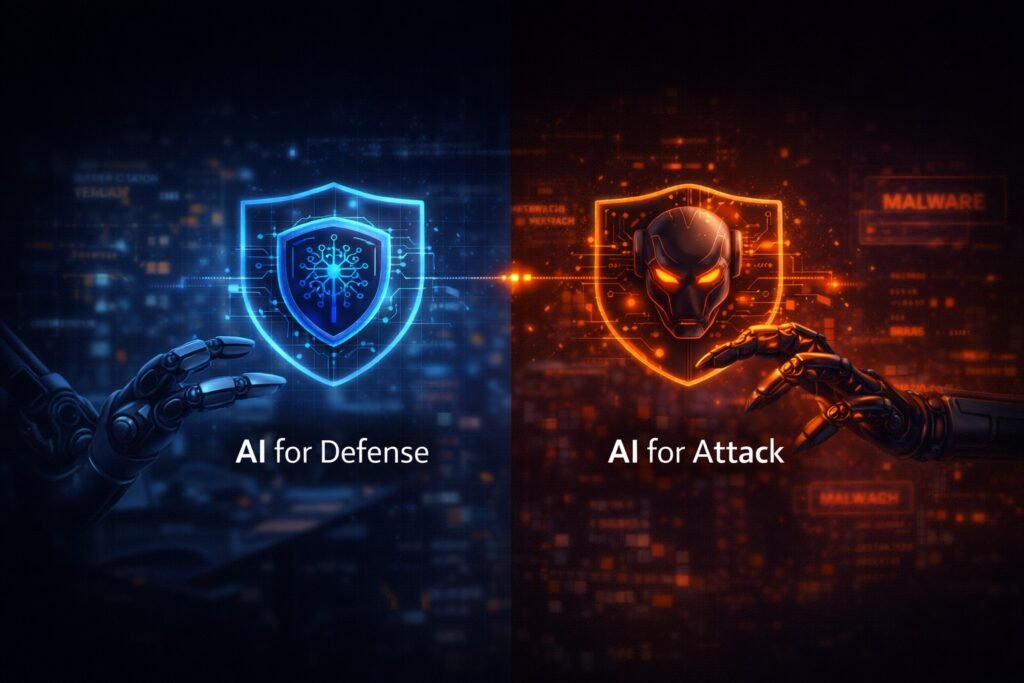
Here is the uncomfortable truth about AI and security. The same technology that is making organisations safer is also making them more vulnerable.
On the positive side AI is genuinely transforming threat detection. Tasks that used to take security teams days to complete, analysing logs, identifying anomalies, flagging suspicious behaviour, can now be done in minutes. AI systems can process millions of data points simultaneously and catch patterns that a human analyst would miss entirely. For organisations with limited security resources this is a genuine breakthrough.
But attackers have access to the same technology.
AI is enabling a new generation of cyberattacks that are faster, more sophisticated and significantly harder to detect. AI-driven phishing emails that perfectly mimic the writing style of a real colleague. Deepfake video and audio used to impersonate executives and authorise fraudulent transactions. Automated attacks that can probe thousands of vulnerabilities simultaneously and adapt in real time.
“AI is enabling faster threat detection, from days to minutes, but also allowing attackers to scale sophisticated attacks such as AI-driven phishing and deepfakes.”
Avijit Patra, AI Agile Synergy Webinar (14:36)
| AI-related risks moved from number 30 to number 5 on the World Economic Forum Global Risk Report in a single reporting cycle. |
That is not a gradual shift. That is a signal that the world’s leading risk experts believe AI has become one of the most significant global threats in an extraordinarily short period of time. Not because AI is inherently dangerous. But because the speed of adoption has outpaced the speed of governance.
“The biggest concern is not just the technology itself, but the incorrect outcomes generated by AI and the fear of missing out driving rapid, ungoverned adoption.”
Avijit Patra, AI Agile Synergy Webinar (20:15)
The Three Biggest AI Security Risks Organisations Face Right Now
When I speak with business leaders about AI security, three risks come up consistently. Not because they are the most technically complex. Because they are the most common and the most damaging.
Risk 1. Shadow AI: The Threat You Cannot See
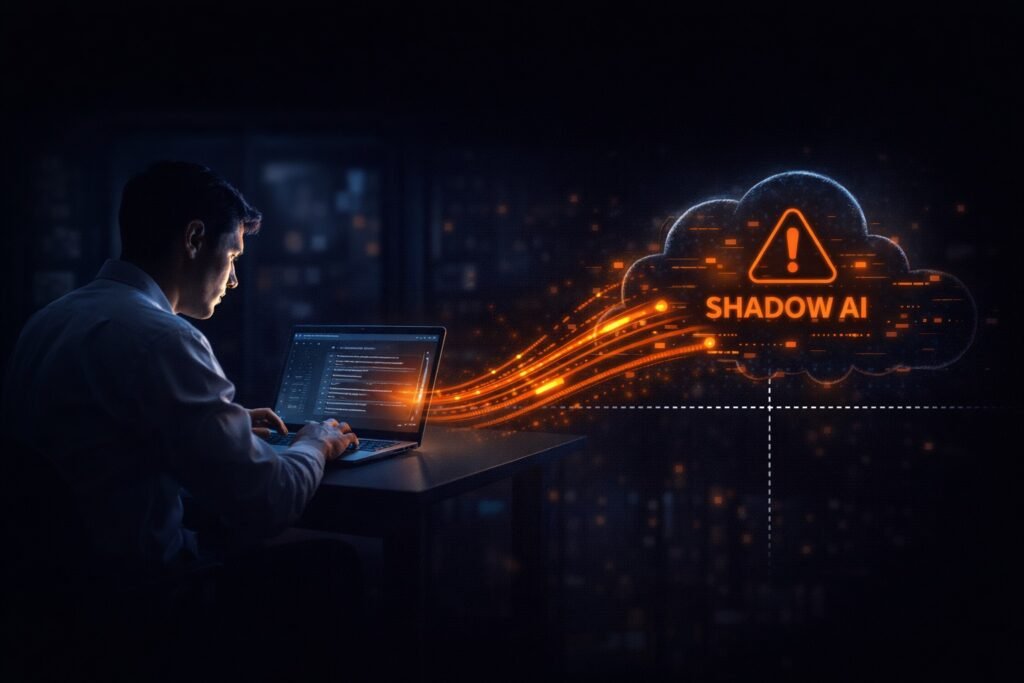
Shadow AI is the single biggest security risk most organisations are completely unaware of.
“Shadow AI, employees using public, unlicensed tools to input sensitive company data, is the single biggest security risk.”
Avijit Patra, AI Agile Synergy Webinar (29:30)
It refers to employees using public, unlicensed AI tools that the organisation has not approved, not reviewed and has no visibility over. They are not doing anything malicious. They are trying to be more productive. But when they paste a client’s financial data into a public AI tool, or upload a confidential document to get it summarised, that data leaves the organisation’s control entirely.
Where it goes, how it is stored, who can access it and whether it is used to train future AI models is completely unknown. Most employees have no idea this is happening. Most organisations have no way to detect it. And it is almost certainly happening inside your organisation right now.
Risk 2. AI-Powered Phishing and Deepfakes
Traditional phishing emails were relatively easy to spot. Poor grammar, generic greetings, obvious inconsistencies. AI has changed that completely.
Attackers can now generate highly personalised phishing emails that reference real details about the target, mimic the writing style of trusted contacts and arrive at exactly the right moment to be convincing. The emails do not just look legitimate. They feel legitimate.
Deepfakes take this further. AI-generated video and audio of real people saying things they never said. There are already documented cases of finance teams transferring significant sums of money after receiving deepfake video calls from people they believed were their own executives. The technology required to create these attacks is no longer expensive or difficult to access.
Risk 3. Moving Too Fast Without a Plan
The third major risk is not a specific attack. It is a mindset.
Organisations driven by the fear of missing out on AI are deploying tools and systems without adequate governance in place. Security is treated as something to figure out later. Compliance is reviewed after deployment. Legal obligations are considered only when something goes wrong.
In AI, later is often too late. Every system deployed without a clear governance framework is a potential liability. Not just a security risk, but a legal and reputational one too.
Technology Is Not the Weakest Link. People Are.
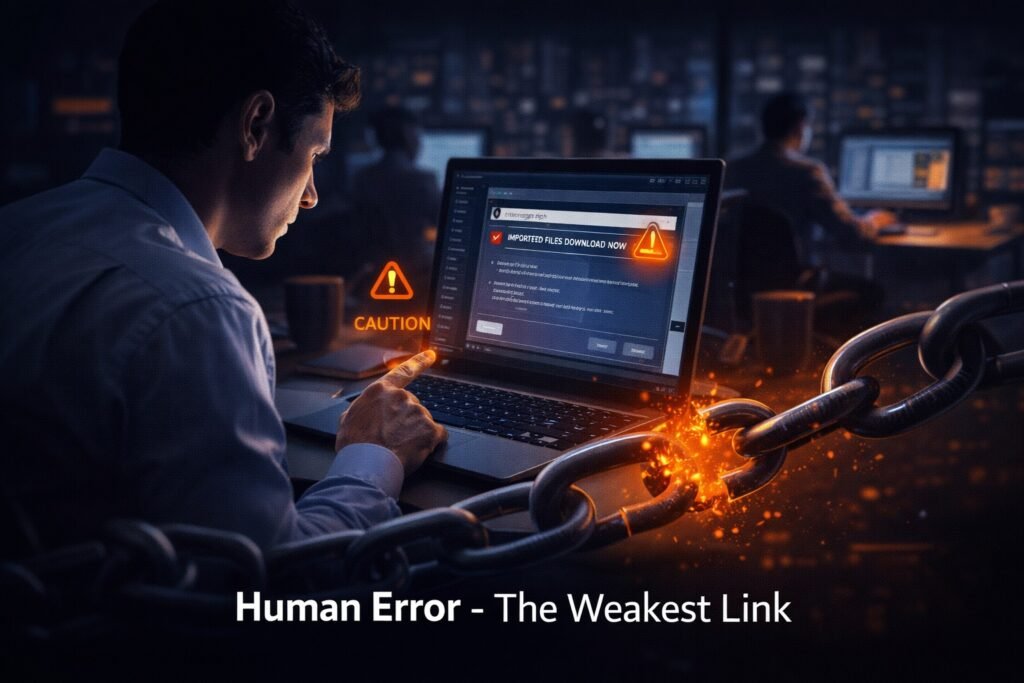
“Human error remains the weakest link.”
Avijit Patra, AI Agile Synergy Webinar (47:40)
Every sophisticated security system in the world can be undone by a single human error. A well-crafted phishing email that looks exactly like a message from HR. A password reused across a personal account and a company system. An employee who genuinely believes they are helping by sharing data with an AI tool that makes their job easier.
These are not the actions of careless people. They are the predictable behaviours of people who have not been given the context they need to make better decisions.
This is why security culture matters as much as security technology. You can invest in the most sophisticated AI security tools available and a single uninformed employee can render all of it irrelevant.
The organisations that will navigate AI security well are not necessarily the ones with the biggest budgets. They are the ones that invest in making sure every person in the organisation understands the basics. What to share, what not to share, what to do when something feels wrong, and who to tell.
Not sure where your organisation stands on AI security?
I offer a free, no-obligation conversation to help leaders get clarity on their current risks and what to prioritise. No sales pitch. No jargon. Just an honest discussion.
The Next Wave: Why Agentic AI Changes Everything
Most AI tools today respond to instructions. You type something, the AI produces an output, and a human decides what to do with it. The human stays in the loop at every step.
Agentic AI is different.
Agentic AI acts autonomously. It makes decisions, executes tasks and interacts with other systems without waiting for human input at every stage. Think of it as the difference between an AI that gives you directions and an AI that drives the car.
“In the next 3 to 5 years, agentic AI, autonomous decision-making systems, will be the major challenge, requiring new frameworks for secure interaction.”
Avijit Patra, AI Agile Synergy Webinar (44:10)
In the next three to five years agentic AI will become mainstream in business operations. Systems that book meetings, send emails, execute transactions and manage files without a human approving each individual action. For productivity this is remarkable. For security it introduces a level of complexity that current frameworks are simply not designed to handle.
An attacker who compromises a traditional AI system gains access to data. An attacker who compromises an agentic AI system gains the ability to act at scale and at speed on behalf of the organisation.
We do not yet have widely adopted frameworks for securing agentic AI interactions. Organisations that start thinking about this today will be significantly better positioned than those who wait until the technology is already embedded in their operations.
Five Practical Steps Every Organisation Should Take on AI Security
Understanding the risks is the first step. Doing something about them is the second. Here are five practical steps every organisation should take right now, regardless of size, industry or how far along you are in your AI adoption journey.
1. Secure Your Data Before You Deploy AI
“The first thing to secure before deploying AI is the data itself.”
Avijit Patra, AI Agile Synergy Webinar (48:06)
Map what data exists in your organisation, where it lives, who can access it and what happens when an AI system processes it. You cannot secure what you cannot see. Data mapping is not glamorous work. But it is the foundation everything else is built on.
2. Create a Clear AI Usage Policy
Every organisation needs a written policy that defines which AI tools are approved for use, what data can and cannot be shared with those tools, and what happens if someone uses an unauthorised tool. This is the most direct line of defence against Shadow AI. It does not need to be a lengthy legal document. It needs to be clear, accessible and actively communicated to every employee who uses AI in their work.
3. Build Security In From the Start
Security cannot be an afterthought. Every new AI project should have security reviewed at the design stage, not after the system is already live. This is what security professionals call shifting left. Catching problems early when they are cheap and easy to fix rather than late when they are expensive, damaging and visible.
“Security must be integrated early. This is the shift left mentality.”
Avijit Patra, AI Agile Synergy Webinar (2:35)
4. Train Your People Not Just Your Systems
Technology alone will not solve this. Every person in your organisation who interacts with AI tools needs to understand the basics of AI security. What is safe to share, what is not, how to recognise a suspicious request and who to contact when something feels off. Regular, accessible training is not optional. It is the single most cost-effective security investment most organisations can make.
5. Know Your Legal Obligations
In India the Digital Personal Data Protection Act, known as the DPDPA, holds organisations legally accountable for how personal data is handled, including data processed by AI systems. Penalties for non-compliance can reach up to 250 crore rupees. Understanding your legal obligations is not just good practice. It is a business necessity. If your organisation handles personal data and uses AI to process it, you need to know exactly what the DPDPA requires and whether your current practices meet that standard.
The Gap Between AI Being a Tool and a Vulnerability Is Governance
“The gap between AI being a tool for security or a vulnerability will be determined by the enforcement of governance.”
Avijit Patra, AI Agile Synergy Webinar (50:50)
AI is not inherently dangerous. It is a powerful amplifier. It amplifies capability, speed and scale. And it amplifies risk in exactly the same measure.
The organisations that will use AI to their advantage are not the ones moving fastest. They are the ones moving most deliberately, with clear governance, trained people and security built into every layer from the beginning. Speed without structure is not a competitive advantage. It is a liability waiting to be discovered.
The conversation around AI security is no longer a technical one. It is a leadership one. And it starts with asking the right questions before something goes wrong, not after.
Want to talk about where your organisation stands?
I offer a free, no-obligation conversation for leaders navigating AI adoption and security decisions. No jargon. No sales pitch. Just clarity on where you are and what to prioritise next.
About the Author
Avijit Patra is a cybersecurity and AI governance expert who helps organisations navigate the intersection of technology adoption and risk management. He speaks and writes on AI security, digital trust and the practical realities of securing AI systems in business environments. Book a free conversation with him at avijit.in.